Ralph Hänel (1935 - 2025)
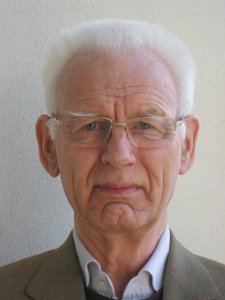
On December 19, 2025, German Geophysicist and heat flow expert Ralph Waldemar Hänel, born 19 May 1935, passed away, at the age of 90. He was known for his precision and straightforwardness in life, both professionally and personally. To some, he may therefore have seemed somewhat stiff - a typical representative, so to speak, of the somewhat bureaucratic Geological Survey (NlfB, GGA) in Hanover. However, those who knew how to interpret the sparkle in his eyes understood that this was a form of camouflage which he used to conceal his friendly, affectionate nature and his free spirit, depending on the situation and surroundings.
After finishing primary school, completing an apprenticeship, and working as a machinist, all in his native city of Dresden, he earned his high school diploma in Freiberg (Saxony) in 1955. He then moved on to study geophysics at the mining academies in Freiberg and, after having left East Germany, in Clausthal. He completed his studies in 1961 with a thesis on the design principles of a shaking table for calibrating geophones.
He then moved to Hannover in 1961, where he began and continued his scientific career until his retirement on January 1, 1998. Initially, he worked in the Seismology Division of the Federal Institute for Geosciences and Natural Resources (BGR). But from 1965 onwards he worked at the Lower Saxony Geological Survey (NlfB), where he headed the Geothermal Division until 1986. During this time, he collected temperature and heat flow data in Germany as well as abroad. This allowed him to estimate geothermal resources and reserves as well as potential uses of geothermal energy. In addition, he developed probes for marine and lacustrine heat flow measurements.
At the same time, he wrote his dissertation, “Studies for assessing the terrestrial heat flow in Inland Lakes” and was awarded the doctoral degree (Dr. rer. nat.) from the Clausthal University of Technology in 1968. In 1973, he started teaching at the Institute of Applied Geophysics, Petrology, and Mineral Resources Research at the Technical University of Berlin. He completed his habilitation there in 1980, received the venia legendi in geophysics, and was appointed adjunct professor of geophysics in 1986.
From 1989 to 1991, Hänel headed the Geophysics Division of the NLFB’s Geoscientific Task Force Department, which later became the Leibniz Institute for Applied Geophysics in Hanover. In the wake of the unification of both Germanies, this period was marked by an expansion of the Joint Geoscientific Task Force Department, which he directed from 1992 to 1998 until his retirement. During this time, he initiated and led the large-scale project “Groundwater Quality Development in the Lignite Mining Areas of the New Federal States” (GBL), which was funded by the federal Treuhand Agency. Furthermore, he actively supported the establishment of the geological surveys in the new federal states and the safeguarding of geoscientific data repositories.
In the Federal Republic of Germany’s Continental Deep Drilling Program, he directed the borehole geophysics working group with great dedication from 1986 to 1989. From 1975 to 1989, he served as an expert rapporteur for the European Commission, evaluating geothermal research projects. From 1975 until 1987, he was a member of the International Heat Flow Commission of IASPEI. In 1978, he co-founded the Training Center for Geothermal Energy in Reykjavik (Iceland) for the United Nations University, headquartered in Shibuya (Japan). From 1991 to 1997, he served the German Geophysical Society (DGG) as Designated Chair, Chair, and Vice-Chair.
Together with Oskar Kappelmeyer, he authored the book Geothermics in 1974, and with Ladislaus Rybach and Lajos Stegena he edited the “Handbook of terrestrial heat- flow density determination” in 1988, which still form standard references on geothermal processes. Hänel authored over 100 technical articles in scientific journals and was the author, co-author, and editor of monographs on geothermal energy and atlases on geothermal energy in Europe. This, along with his research – particularly his geothermal measurements in Germany, Israel, and Norway – established his high international reputation. In 1995, recognizing his contributions to the publication of atlases on subsurface temperatures and geothermal potentials in Europe, the German Geothermal Association awarded him the Patricius Plaque.
In his retirement, he was struck by a serious illness, which he bore with great discipline, as was his nature. He follows his wife, who passed away one year earlier, and leaves behind a daughter, a son, and three grandchildren.
His colleagues and doctoral students, among whom we were privileged to be included, owe him a great deal and will honor his memory.
Heiner Villinger (University of Bremen) and Christoph Clauser (RWTH Aachen)